There is a way mustard oil wants to be used in a Bengali kitchen, and there is a way it ends up being used in a Western one. The difference is not the seed and it is not the pan. It is four small principles of order — what goes in first, what waits, what changes the oil before the spices touch it. Get these in the right sequence and a sarson tadka tastes the way it does in a Calcutta home. Get them wrong and the oil tastes raw.
We learned these from cooks in Howrah and Burdwan and the smoking kadhais of an aunt’s kitchen, where every fish curry begins the same way and no one bothers to write it down. Here it is written down.
Principle one — the first smoke
Cold-pressed mustard oil has a sharpness on the nose. It is the allyl isothiocyanate — the same compound that makes wasabi sit up in your sinuses. Eaten in small amounts it is a flavour. Eaten in raw spoonfuls it is a discomfort.
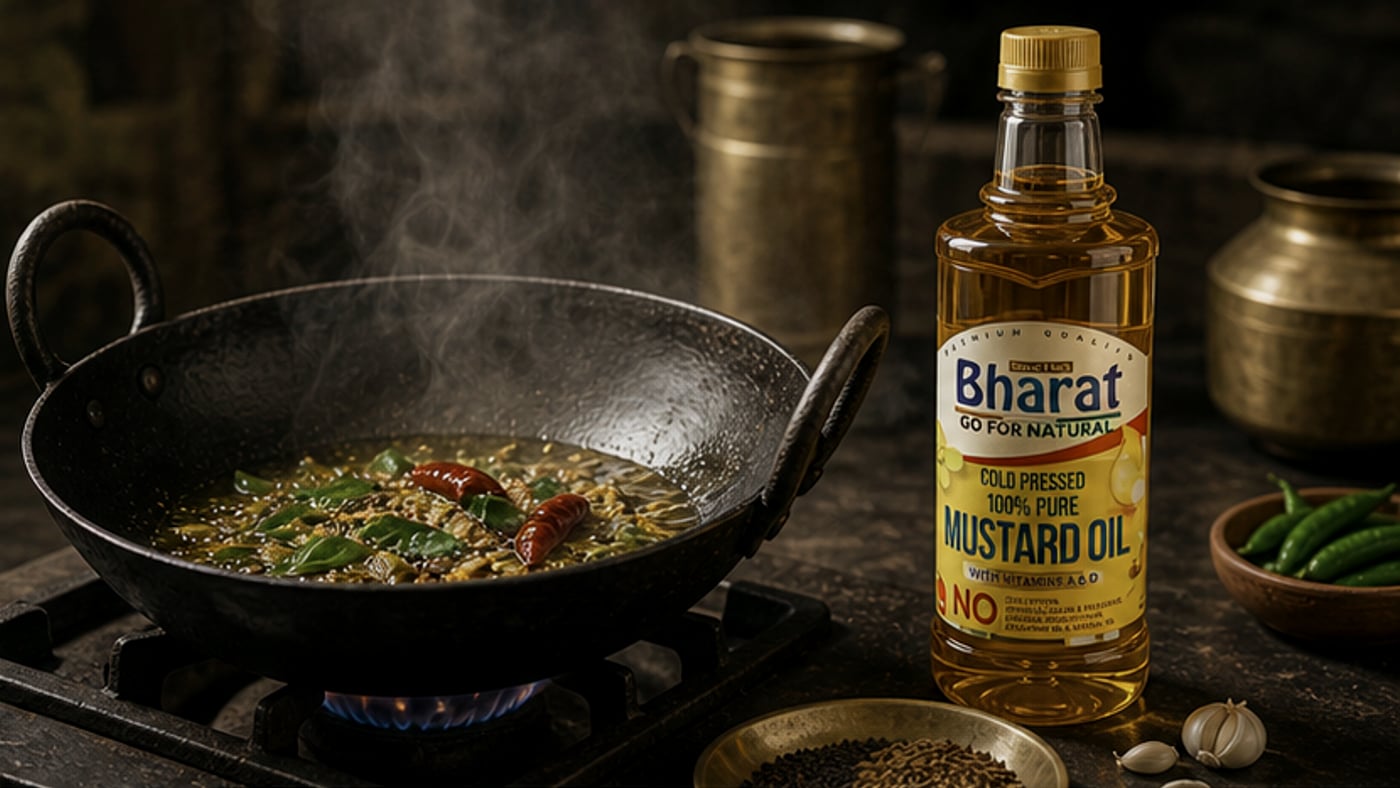
The first principle is therefore the first smoke. Heat the oil in a dry, clean kadhai over medium-high flame. Watch the surface. When the first thin curl of white-blue smoke rises and the pungency drops back, the oil is ready. This usually takes one to two minutes. The volatile sulphur compounds that bite have burned off; what is left is the round, nutty mustard character that finishes a dal or a fish curry.
What you do not want: an oil that has been heated past first smoke into rolling smoke. That oil is now breaking down. Pull it off and start again.
This first-smoke step is what defines kachi ghani mustard oil cooking in Bengali, Punjabi, and Odia kitchens. Refined mustard oil — already deodorised — does not need it. You will not gain much by heating it. You will also not gain the flavour you bought a cold-pressed bottle for.
Principle two — the second crackle
After the first smoke, drop the heat to medium and add the tempering spices. For a classic Bengali fish curry or aloor dom, that is panch phoron — a five-seed mix of cumin, fenugreek, nigella, fennel, and black mustard seed in equal parts.
The seeds go in dry. They will sizzle, then crackle. Wait for the second sound — the panch phoron does not just hiss, it pops. Fennel goes first, mustard second, nigella third. The fenugreek darkens last and that is the cue.
The second principle is the second crackle. The point at which fenugreek turns a shade darker is the point at which everything else is ready. From the time the seeds hit the oil to the time they are ready is fifteen to thirty seconds, no longer. Past that, fenugreek turns bitter and the whole tempering is lost.
If you are using mustard oil for a non-Bengali tadka — sarson with cumin and chilli for a Punjabi dal — the rule still holds. The cumin crackle is your signal. The instant it darkens, the next thing goes in.
Principle three — the third pour
The third principle is the order of the wet ingredients into the now-tempered oil. Ginger-garlic paste before onion. Onion before tomato. Tomato before turmeric. Turmeric before any of the deep-spice mixes (cumin powder, coriander powder, red chilli).
The reason is moisture. Each ingredient brings its own water and its own cooking time. Ginger and garlic want a brief, hot toast in oil — thirty seconds — to take the rawness off. Onion wants a longer, slower sweat to bring its sugar up. Tomato collapses fast and releases water, which is what brings the deep spices safely into the mix without burning them. Powdered spices added to hot oil without that protective tomato water will scorch in seconds. Powdered spices added after the tomato will integrate without burning.
This order is not a recipe — it is the engineering of a sarson-base gravy. Every Bengali curry has its own variation, but the order of the pour is not one of the variables.
Principle four — the fourth rest
The fourth principle is the rest. After the curry has come together, after the fish has been added, after the gravy has tightened, the heat goes off and the lid goes on. Five minutes. No stirring.
The fourth rest does two things. It lets the oil rise back to the surface — a thin, deep-amber ribbon of mustard oil that proves the dish is finished. And it lets the flavours that the high heat introduced settle into the gravy at a temperature where they can mingle rather than burn.
Bengali cooks call this “leaving the curry to think.” Tamil cooks have the same step under a different name. The principle is universal: a dish made on high heat needs a few minutes of low heat to finish itself.
What this looks like at home
A maacher jhol, the everyday Bengali fish curry, is the test case. Heat the kadhai. Add cold-pressed mustard oil. Wait for the first smoke. Add panch phoron and wait for the second crackle. Add ginger paste, then onion paste, then tomato, then turmeric. Let it cook out. Add the fish, the chilli, salt, water. Cover. Five minutes off the heat at the end.
Done in this order, mustard oil does not taste like the bottle. It tastes like a dish. That is the whole point of a tadka — to take an oil that has been sitting in a bottle and put it into a state where it carries flavour rather than merely contributes to it.
What we leave to the aunts
There are corrections an aunt would offer to every line in this piece. She would say the panch phoron varies between districts. She would say the fish dictates the temperature of the oil. She would say maach diye dile thik holo na — the fish, dropped in too soon, has ruined it. We are not arguing with her. We are writing down the four principles that hold across her corrections.
The kadhai is the same in Howrah and Sangli. The seed is the same. The oil that comes out of our press in Maharashtra and the oil her grandmother bought from a press in Kolkata are doing the same thing in the pan. Sixty years on, the technique that makes them sing has not changed.
Since 1965. Unchanged on purpose.